
Submarine off Highway 101
a fast-food hamburger restaurant called Frugals

On the northern coast of Washington’s Olympic Peninsula, along the Strait of Juan de Fuca, less than ten minutes from the Port Angeles city pier just off of Highway 101, there is a fast-food hamburger restaurant called Frugals. The restaurant, which is part of a small chain with locations in Washington and Montana, looks like a submarine wrenched up out of water, flipped upside down, and hammered into the asphalt. It is a cuboid but with rounded edges, made of aluminum siding with two large drive-through windows cut out of it. Around its top, there is a teal trim and, from the roof, four spiral protrusions that resemble the propellers on the stern of a big ship, but instead of turning water, they turn greasy fumes up out of the kitchen.
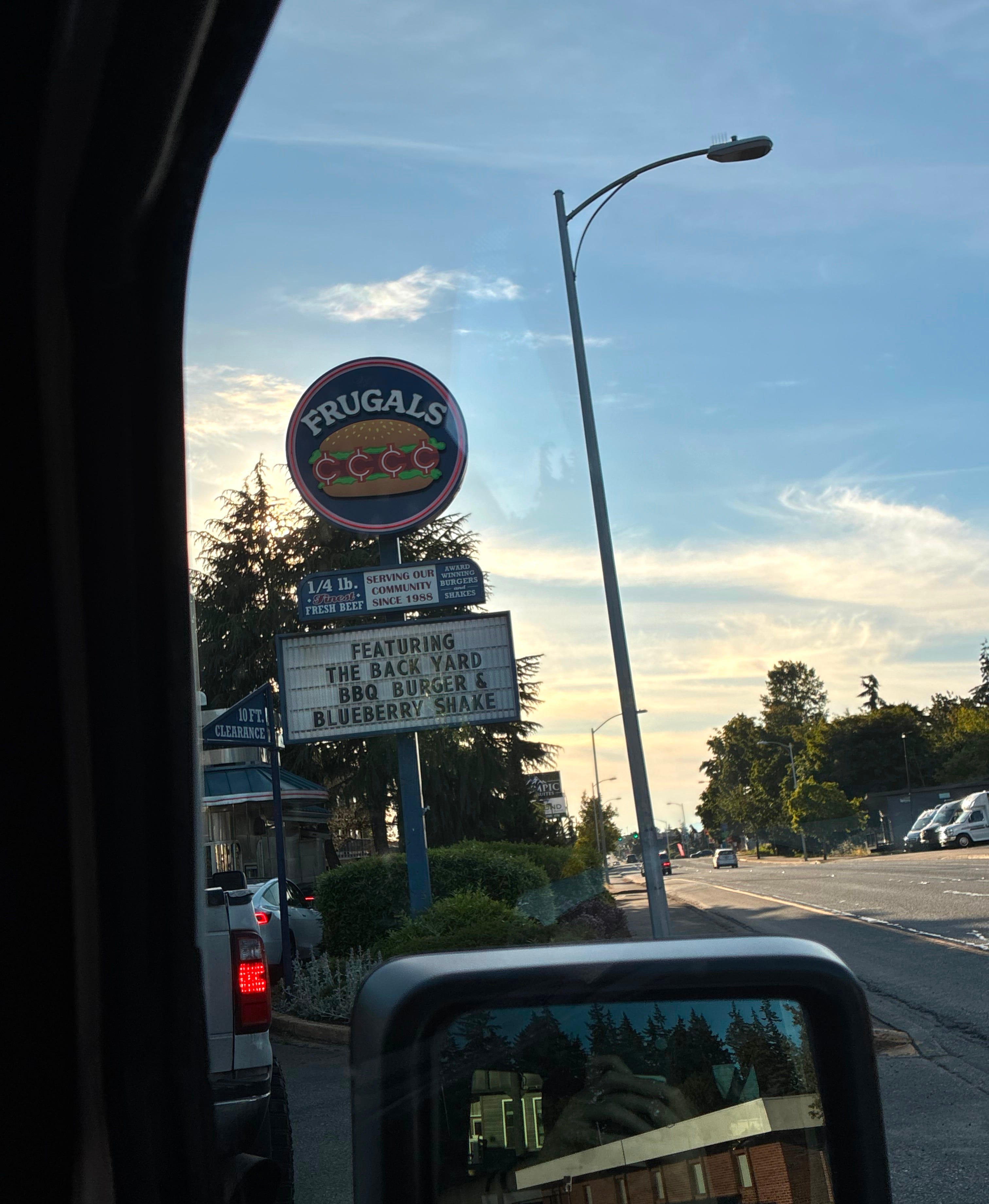
On the roadside, next to the restaurant, there is a tall blue pole, with the Frugals logo at its top: a hamburger with two beds of bright green lettuce and four cents symbols (¢) stamped into the patty. Beneath the logo are two rectangular signs that read:
1/4 lb. Finest Fresh Beef Serving our community since 1988 Award Winning Burgers and Shakes Featuring the Back Yard BBQ Burger and Blueberry Shake
Frugals is drive-through only. In the evenings, between 6 and 11pm (when Frugals closes), around the time when small children gather along the Port Angeles city pier to look for seals and otters until the sky goes black and they cannot look anymore, there is a line of cars that coagulate on the shoulder of the highway, then fork into two lanes, to the drive-through windows on either side of the restaurant. In the left lane, customers must pay through the passenger’s window, which, as per Google reviews, can get rather uncomfortable if there is no passenger.
Inside, the restaurant is a single room in which employees take customers’ orders, flip hamburgers, fry cheese curds, blend award-winning milkshakes, then shovel everything into thin paper take-out bags and hand them out to customers. The credit card reader—its display fogged up and buttons lined in grease—passes through the window, from employee to customer, for the card to be stuck in and the green button to be thumbed, and then back to employee again, until the customer drives off and the next one rolls up, right behind, and the greasy shuffle repeats.
In a real submarine, one that operates under the sea, where there is black water outside but no windows through which to see it, there are anywhere between 130 and 150 crew members. They sleep in racks, bunks stacked three high, each just large enough for a body to fit, with a curtain and a small reading light. The crew sleeps in shifts so that some combination is always awake, bustling about the ship, reading pressure gauges and monitoring oxygen levels, listening for traffic on the radio, driving the big vessel that everybody else is sleeping in. Often, submarines do not have enough bunks for all crew members to have their own, so some must share, one working while the other sleeps, warming the bed with his body heat before shuffling out for the other to roll up right behind, like the cars in the Frugals drive-through machine.
There is no night on a submarine, because the light from the sun never reaches the crew, sealed in a steel tube hundreds of feet underwater. Some submarines use colored overhead lights, white during the day and a waxy red during the night, an attempt to be something like the sun, or maybe just to remind that the sun still exists. I have never been in a real underwater submarine, and I have only ever seen one once, when I was a child and my father took me to the Submarine Force Museum in a coastal town called Groton, Connecticut. The submarines were laid out on display, parked dry on land with their doors hanging open and their tops warmed by the sun, some with manikins inside for crew members. They let me click the buttons in the control room and pull some levers that did nothing and made the ship go nowhere, for it was stuck in the ground something like the Frugals in Port Angeles.
I picture lying inside an underwater submarine, in my sliver of a cot, curtain drawn, all of us plunging into the ocean, steel cloaked in cold saltwater, with no windows and all the doors doubly locked, descending further and further from the sun until we forget what the sun even looks like, everyone wrapped up inside like threads in a fleece sweater. I remind myself that, probably, riding in a submarine is much less cozy and much more uncomfortable than I imagine it to be.
The ¼ pound Frugals burgerTM costs $4.95. The cheeseburger costs a dollar more. The regular-size fries cost $2.75. The regular-size shake—which is award winning and comes in the flavors chocolate, strawberry, vanilla, huckleberry, and orange creamsicle—costs $5.95. On a submarine, there is milk and fruit and eggs for the first couple of weeks, before they go bad and the crew turns to canned and dehydrated foods. For what might be up to 90 days, they eat canned beans and dried proteins, and fresh bread made steaming hot with flour and water and yeast. They store the food on the floor of the submarine, in boxes, over which everyone stands and walks. As the crew eats, the submarine gets lighter and more spacious, until there is so much space that the crew begins to worry that it’s running out of food. Frugals gets a new stack of patties every three days or so, from the outside world, which consists of cattle and meatpackers and distributors with big trucks that come in the mornings, before there are any customers. All the beef is fresh and never frozen, and they say so on their website.
I ordered a bacon bleu burger off of Frugals’s secret menu (which I found online), along with the cheese curds and a chocolate milkshake. For a moment, when I rolled up to retrieve my order from the window, I felt like I was looking into a submarine, like at the museum except with people instead of manikins, crew members stepping over and around each other, flipping patties with metal spatulas, lugging tubs of ketchup to refill the dispenser. Beads of salty sweat ran down my server’s forehead. His apron was blotched with frying oil and his hair was wet around the frame of his face, like a vegetable boiled in the summer heat. I stuck my card into the reader, collected my food, and then drove the rest of the way down to the city pier, where I sat at the picnic table overlooking the ocean, plucking cheese curds out of the paper bag and watching for the pier’s resident harbor seal to poke her head out of the water.
The sun melted down like a soft-boiled egg, oozing with an undercooked yolk of fat fish and stray geese and loud birds. The bacon bleu burger tasted strongly of blue cheese, which I enjoyed. The patty was thin with a crust on its exterior, chunks of the cheese softening overtop it. The bread was not soggy. It was dotted with sesame seeds and streaked with flour, I imagine straight out of the packaging. I found the milkshake too sugary, reminiscent of the colorful sugar sticks that we used to eat as children, sitting on the slide on the elementary school playground, sticking the thin paper tubes into our mouths and sucking up the grains of sugar until our tongues turned blue and green, or sometimes just more red than is ever normal for a human tongue.
The United States West Coast submarine base is called Naval Base Kitsap–Bangor, and it lies along the Hood Canal about 20 miles west of Seattle. To get from the base out into the Pacific Ocean, or back, the submarines pass through the Strait of Juan de Fuca, the channel separating Washington’s Olympic Peninsula from Vancouver Island. Port Angeles, where I waited for the harbor seal to peel her head up over the water, overlooks the strait. Sometimes, if I believe what other people have said on the internet, one can see submarines from the Port Angeles pier, their upper decks breaking up out of the surface. I ate my cheese curds, biting the cheese and then stretching it out as far as it could go before snapping, and I watched a fisherman hang his line lazily into the water. Beside me, a mound of ants crumbled over each other on the picnic table. I imagined that under the water’s surface, just beyond the pier, there was a conglomeration of submarines, Frugals but with no windows, yanked from the asphalt and pushed back into the water. Inside, the vessels heated water into steam, up through their turbines, spinning water backward, carrying hundreds of little people stacked up over each other.
Loved the back and forth !